Wednesday, November 17, 2010

midlist


It was interesting to me to read comments on my republished post Ranting on Amy (read the comments from the original posting 4 years ago HERE). As I said in comments, I did write that rant 4 years ago so a lot of things have changed (especially my thoughts on greatness), but it was the inquiries on my label "midlist" that captured my attention this time.

According to Wikipedia: authors who consistently publish acceptable but not bestselling books are referred to as Midlist authors.

Personally, I'm not sure where I am on the hierarchy. Thanks to the Newbery Honor (which I will always be eternally grateful for!), I have one book that broke out of the midlist. I have many that fell way below, but most are solidly in the middle. The hope is that the success of Where the Mountain Meets the Moon has opened a door (or cracked a window) for my future books to sneak through. Of course, that is the Hope with a capital H. As with everything in publishing, you just don't know. That door (or window) can slam shut at anytime.

But, let's just say that is the case (double crossing my fingers I am not jinxing myself), I'll know that what has allowed me to climb up has been my stack of midlist titles. Each one of my non-bestselling books are responsible for my growth as an author and illustrator so that I could write a Newbery Honor book. And each midlist book gained my work more readers. They weren't big numbers, but those small groups started adding up--contributing to the large readership of Where the Mountain Meets the Moon. That is to say, if I succeed in breaking out of the midlist, I truly believe it will have been my midlist titles that have gotten me there.

Which is why articles like this worry and sadden me. The first line of the article proclaims, "The midlist is dead!"

I know the PW article is mainly talking about adult books, not children's books, but it's still a disturbing trend. Most authors just don't have a blockbuster bestseller right out of the gates. Some authors need a couple of books to grow and blossom. Someone (I don't remember who) called these writers "slow-burning authors"-- they write books whose fan base is growing but have not hit that peak capacity yet. I have a feeling I am one of them.

Without a midlist, where will they go? Where will we go? The article seems to indicate smaller presses will be the life vest for midlist authors in the future. What do you think?

Monday, November 15, 2010

The future of publishing


Meghan's post last week about the Barnes & Noble color Nook drew some great discussion. I think everyone in the publishing industry has been someone holding their breaths to see just how this whole digital publishing thing shakes out. Well, not holding our breaths, exactly. We're all doing things, hiring more people, creating new divisions, but we're all kind of stumbling around in the dark a bit. Some of us are excited about all of the changes going on, and some of us are worried if we'll all survive. And some of us are both (me).

In terms of the question "Why do eBooks cost so much," I thought I'd link to this publisher's perspective. In it, the CEO of Thomas Nelson Publishers states that there are three new costs associated with eBooks: digital preparation, quality assurance, and digital distribution. He also states that:
physical manufacturing and distribution expenses cost less than you think. Some people assume that these two items represent the bulk of a book’s costs. They don’t. Together, they account for about 12% of a physical book’s retail price. So eliminating these costs doesn’t do much to reduce the overall cost structure.
As I mentioned in the comments, another new cost associated with eBooks is fighting piracy--Hachette Book Group has partnered with a company that monitors the internet and send take down notices when necessary. Incidentally, if you ever see an illegal download available for one of our books, you can report it here, and someone will look into it.

I'm not crazy about eBooks myself. I have yet to actually read a published book on my Sony Reader, although I do LOVE LOVE LOVE my Sony Reader for reading manuscript submissions, and am so happy I don't have to lug heavy manuscripts around with me wherever I go. But for published books, I still prefer paper books, and I probably always will. I especially love paper picture books. Although I will say, the color Nook and the iPad are more appealing to me for published books than the Kindle or Sony Reader, because the design of the book stays more true to the paper book, and that's important to me. And some of the picture book apps I've seen on the iPad are pretty darn cool. But I see eBooks as another format of the book, just like a paperback, hardcover, or audio edition. It's another opportunity to reach consumers.

The change isn't really being initiated from the publishers or authors. Just as with the music industry, the change did not come from the record labels or musical artists. It came first from the technology sector. A product was created that consumers embraced. And I suspect that's what's happening with the publishing industry. Some feel that there will be a demand for electronic readers. They never really stuck before, but it's starting to stick now--although to what extent remains a mystery. Will eBooks replace paper books completely in the future? Or will they plateau and coexist with the other formats? Either way, we have to work to adapt, and we're all finding our way. I think a case in point is this article about a e-Books rights panel in September. Publishers and agents argued about the royalty rate and the costs of making eBooks:

Inevitably, though, the conversation looped back to that digital royalty issue. Moderator Jim Milliot’s question about what the costs for publishers actually are in creating digital books not only led to Aiken’s aforementioned math but, again, to a back-and-forth between the panelists. While DeYoung said profitability needs to be measured across all publishing formats and that a publisher’s costs can’t be measured “in a vacuum,” Aiken pressed the notion that the current digital royalty rates cannot stand.

I don't know the right answer to Meghan's question of how authors and illustrators will get paid fairly. Right now, I do feel that publishers are incurring all of these new costs, and who knows what will work and what won't. But eventually the market will settle into a model that works for both the publishers and the authors and illustrators. Well, that's the hope. Because all of the players involved--the publishers, the authors, the illustrators, the agents--want to make sure that we all stay in business and stay profitable, and that all parties can earn a living,

Just this morning I read this fascinating interview of Cambridge University professor John Thompson, who wrote the book Merchants of Culture on the book publishing industry, spending five years researching  the industry in the US and UK. He claims that the changes the publishing industry are going through right now are not mainly due to the rise of eBooks:

It’s at a bit of a critical juncture but it’s not necessarily because of the rise of electronic books. It’s the outcome of two interwoven processes—one that is social and economic and one that is technological, each of which has its own history. On the social-economic side is a process that began in the 1960s and led to a gradual transformation in the field of trade publishing. This process was shaped by three factors: One was the growth of the retail chains and the revolution of retailing, the second was the rise of the literary agent, and the third was the consolidation of publishing houses under the umbrella of large corporations. And those three processes led to a social and economic transformation in the field of trade publishing that’s effects are felt today.

He also mentioned the rise of the agent as a factor in forcing the consolidation of the publishing houses, forcing smaller houses like FSG to Knopf to be swallowed up by the big corporations:

But once the agents became significant players they demanded high advances at a time when retail chains were growing and houses like Simon & Schuster and Random House were coming under the umbrella of large corporations and were able to afford the large advances. Farrar Straus and other publishing houses could therefore no longer play the game—they couldn’t keep their authors and they were out-maneuvered by the larger houses. So they had to decide to sell to corporate owners and it was no longer possible for those once-independent publishing houses to remain independent. So the field became polarized where you have a small number of large, corporate groups that now own the former independents because they have deep pockets and then small presses.

It was a quite enlightening interview to read--I think I may have to read his book! And I was happy that he ended the interview on a hopeful note. I do love the hopeful endings, could be why I'm editing books for kids and teens.

I think it’s important not to take an apocalyptic view of the future of the book and the future of publishing. You have to counter that with the fact that books really matter to people. There are many people who just love books and they love the ideas that are expressed in books; they love the stories that are told through books and all of it. They’re very attached to it. You only have to go to a book festival, of which there are more and more these days, like the Brooklyn Book Festival, and see the hundreds and thousands of people who flock to these book festivals—more than ever before—pack the audiences, pack the halls, to hear their favorite authors, or even an author they don’t really know very well but want to get to know, and listen to them talk, hear them read from their books, buy their books, get them signed by the author. They cherish the book. And they believe that this is an artifact that they want in their lives. And some of the technological commentators in this industry just completely miss this point. They fail to see that books have this cultural value in the lives of ordinary people which is very deep and very profound and which is not likely to go away very quickly.

Cherish the book!

Sunday, November 14, 2010

from the BRG archives: ranting on Amy


In Little Women, there is a scene where Amy, after seeing the great works of Europe, decides to give up her ambitions as an artist. Why, Laurie asks, “with so much energy and talent?”

“… because talent isn't genius, and no amount of energy can make it so,” Amy responds, “ I want to be great, or nothing. I won't be a common-place dauber, so I don't intend to try any more.”

Alcott writes this in an approving tone; as if she is applauding Amy for having the maturity to give up on her dreams. Even as a child this bothered me. What was she trying to say? If you can’t achieve greatness, don’t even bother? That your efforts are merely wasted energy in the vortex of creative geniuses? That only the immature, vain and spoiled cling to their disparate talents?

I suppose this rankles a bit deeper in me now that I’ve become an author on the mid-list. Mid-list authors realize how elusive greatness is. Like the sky, no matter how high you climb, it is always above you.

Everyday I am humbled by the amazing works around me; and time and time again I’ve been forced to accept that there are achievements beyond my capabilities. But, still I refuse to accept that striving for it is childish hubris. Maybe it is true "that talent is not genius and no amount of energy will make it so"; but what is more noble than attempting to fulfill your potential? Is it better to waste the gifts you are given because you doubt what you can accomplish? Perhaps, greatness is not the power to awe others, but the satisfaction of excelling within your own limitations.

At one point, Amy thinks of Laurie, “If that's the way he's going to grow up, I wish he'd stay a boy.” I feel the same way about her.

Originally published Aug. 3, 2006

Saturday, November 13, 2010

He finally fell in love with a book!


Some of you may remember my friend Adam, who when he was 7 (he is now 10) had no trouble understanding why writers make so little money once I explained the concept of royalties. He nodded sagely and said,
"Most books are really boring."

More recently, he complained that his teacher last year "made" them read a book a month and how glad he was that school ended "before we had to finish the last one." But now he has read a book that he loved. He's a slow reader, and it took him a YEAR, but he finished it.

So last Sunday, when we went for a hike here,

we mainly talked about books. He described the plot of HIS book in great detail, then explained how 80% of the books published are "terrible," 10% "bad," and the rest, "really good."

He asked me to tell him about the best and worst books I'd ever read--I did, and was surprised that he'd heard of most of the ones I loved:

"Someone in my class read that and thought it was really good," he'd say, or,
"A girl in my class loved that, but I didn't think I'd find it interesting."

He hadn't heard of TREASURE ISLAND and when I told him the beginning, thought it sounded really good, but urged me to tell him the whole story anyway since "I'll never read it." He has just finished the only book he's ever really liked, and wants to read the second in the series. Since the first took him a year, he's not optimistic about starting any other books any time soon. He thought GRIMBLE sounded really, really funny -- he laughed aloud when I quoted it - but didn't want to read that, either: he's saving his reading time for the book after


DORMIA. And yes, this IS the child who said only a little while ago that he liked realistic fiction. He said he liked this because he could picture everything so clearly-- he added that he doesn't like books with pictures because THEY do the imagining for you. He likes really long books because he "hates to choose" and it's good to have something that has "500 solitary pages" --not sure what he meant by "solitary"--he's at an age to use long words to impress).

Lastly, I don't think this proves anything about novels vs. picture books, or realistic fiction vs. fantasy, or kids now or anything else, other than that what makes someone love a book is as completely mysterious and unpredictable as any kind of falling in love. YOU NEVER KNOW, even when you know the person and the book pretty well. I find that encouraging.

Thursday, November 11, 2010

DEAR LION: An Original Letter Poem


We Blue Rose Girls asked our blog readers what we should talk about. Posse addressed the following comment to me: “And Elaine, I love love love each and every poem you share with us.”

I haven’t shared many of my original poems at Blue Rose Girls. I usually post my poetry at Wild Rose Reader, one of the other blogs I write for. From now on, I’ll start posting more of my original work at Blue Rose Girls on Fridays.

Today, I have a poem that I wrote in the form of a letter about fifteen years ago. It has a feminist flavor to it.

LETTER FROM THE QUEEN OF BEASTS
by Elaine Magliaro

Dear Lion,

I’m tired of doing the hunting, the preying
While your only job is to watch the cubs playing.
I’m tired of stalking the zebras and gnus
While you lie around on the grassland and snooze.
I’m tired of running, and pouncing, and killing.
I want a career that is much more fulfilling.
I’m tired, so tired. I’m spent to the core.
I work like a dog! You just eat, sleep, and snore.
I fetch ALL the food. You grow stronger…I thinner.
For the next seven days you can catch your own dinner!
I’m going away for a well-needed rest.
I’ll be seeing you soon.

All my love,
Lioness

**********


At Wild Rose Reader, I have Q & A with poet/anthologist Lee Bennett Hopkins. Last week, my blog readers posed questions to Lee. Click on over to Wild Rose Reader and read Lee’s answers.


Terry has the Poetry Friday Roundup at Scrub-a-Dub-Tub.

GOING DIGITAL?


I was at work the day that B&N launched its new Nookcolor. It’s an e-reader in color. The 4th floor was closed for days in preparation and secrecy. I heard that Hors d'oeuvres and even alcohol was served at the event. No one was allowed up on the floor except those who were invited. That meant customers were barred. Most didn’t give us a hard time though a few gave a bit of an attitude. One customer said “I’m never shopping here again! I’m going to the Strand.” Good go, is what I thought. I hate attitudes.

Anyway, this is what I read on PW: “The addition of color to the e-reading device allowed B&N to officially announce Nook Kids, which in addition to 12,000 chapter books, will have 130 picture books at launch with that number expected to double by the end of the year. Some of the children’s books will be enhanced e-books, featuring video and audio.”

“Initial reaction to Nookcolor from the many publishers in attendance at B&N's New York headquarters was positive, with the addition of color and the price seen as the most exciting features. Color, said the head of one children’s division, “puts children’s publishers in the e-book game.” Also in attendance was Susan Katz, president and publisher of HarperCollins Children’s Book Group, who observed that the presentation, which featured actors and actresses going through a typical day using the Nookcolor, seemed aimed primarily at women, the people most likely to buy picture books. Katz believes that not only will the Nookcolor provide a needed boost to picture book sales, but will also change the way authors and illustrators create picture books in the future, requiring them to keep in mind how the book will look on a screen.”


Boy does this scare me! First of all I can’t imagine having bedtime with a 3 or 4 year old while staring at a little screen, one that cost well over 200 dollars at that! God forbid the child touch it for he or she might break the device! Imagine if it were dropped during a reading? Or drooled on? What about the joy of the page turn? Kids like turning the pages themselves. Sometimes the pages might rip but it’s just paper! Well… it is when it’s a BOOK. And illustrators are expected to now worry about how their art will look in print AND on a screen? Like I’m not driven crazy enough about getting the color right for deadlines as it is.

Also, how do we as authors and illustrators get fairly paid? I still don’t think that’s clear yet.

There was one thing brought up on a list that a librarian mentioned. The devices might be good while at a restaurant or on the subway when the child needs to be entertained. But thinking along these lines, I don’t like this: “Some of the children’s books will be enhanced e-books, featuring video and audio.” Eeek! Maybe we illustrators will become obsolete, in favor of animators and people who can make things interactive.

So you can guess what my vote is on this one. I got a contract for one of my books to go digital and it’s still sitting on my desk unsigned.

Wednesday, November 10, 2010

some fun things (at least for me!)


Don't forget to comment for cookies (and books)! Today is the LAST DAY and we need your suggestions to keep the BRG conversations going!


A couple of things I thought would be fun to share:

First, I've opened an etsy shop. Yes, my brand-new etsy shop, The Grace Lin Gallery is now open! Please come and browse!


And second, Ling and Ting is named one of Kirkus' best books of the year as well as one of PW Best Children's Books of 2010! And, look, that's my name on the Kirkus cover!

That's actually kind of a surreal experience for me because that gives the impression that people might actually recognize my name. It was not that long ago (less than a year, I'd say)that I remember a bookseller saying, "Grace Lin? Never heard of her."

So strange. But fun!

Tuesday, November 09, 2010

Don't forget!


Our contest ends tomorrow! Click here to read all about it... we want to know more about you and what YOU want to hear about on our blog. Comment on this post and we will choose one commenter to get a package of Blue Rose Girl books and cookies made by Grace!! The contest ends tomorrow so don't delay!

ps My Desmond book giveaway is still running too... click here before Nov. 14th to enter to win a free copy of my new book!

pps Is that enough exclamation points for one post? Good.

Monday, November 08, 2010

A Lotta Links from the Wild Rose


I’m sorry for not posting on Poetry Friday. I had all intentions of writing up a poetry post for Blue Rose Girls—but I felt sick on Friday. After I did my posts for Wild Rose Reader and Jonathan Turley’s blog, I had no energy left…and I went to bed. I stayed at home all weekend, ate soup, and I still feel crummy.

Today, I thought I’d provide links to the posts I did last week for Wild Rose Reader—and to some of the posts I wrote for Jonathan Turley’s blog.


**********

As I mentioned in an earlier post at Blue Rose Girls, I’ll be presenting at two sessions at the NCTE Annual Convention in Orlando in November.

One of my sessions is titled Poets and Bloggers Unite: Using Technology to Connect Kids, Teachers, and Poetry (November 19th, Session A.09 at 9:30 am to 10:45 am). Other participants on the session panel will be bloggers Sylvia Vardell of Poetry for Children and Tricia Stohr-Hunt of The Miss Rumphius Effect—and poets Lee Bennett Hopkins, Marilyn Singer, Pat Mora, and Jame Richards. In preparation for the Poets and Bloggers Unite session, Sylvia, Tricia, and I have been featuring the four poets who will be panel members at our blogs. Here are links to my Wild Rose Reader posts featuring Lee Bennett Hopkins:


Wild Rose Reader Posts
Lee Bennett Hopkins: WHY POETRY?

PASS THE POETRY, PLEASE!: A Wild Rose Reader Interview with Lee Bennett Hopkins

A Question for Lee Bennett Hopkins

Lee Bennett Hopkins: A Silent Mentor

The Anthologist: A Poem for Lee Bennett Hopkins


Some of My Posts for Jonathan Turley's Blog
On the Banning, Censorship, and Challenging of Books

Dirty Dog! A Sunday Pooch Poetry Post

The Best Government Money Can Buy: A Video and a Verse

Poetry, Politics, and War

Holy Heil! Women Bishops Verboten

A Bachmann Concerto

Couple Gets Hitched...Limo Gets Snitched

Party Poop Governator Bans Use of Welfare Cards at Psychics, Medical Marijuana Shops, Bingo Halls, Cruise Ships, and Tattoo Parlors

Derailing Progress in the US

Beyond the Book: THE CANDYMAKERS by Wendy Mass


Beyond the Book: THE CANDYMAKERS by Wendy Mass

Description:
Four children have been chosen to compete in a national competition to find the tastiest  confection in the country. Who will invent a candy more delicious than the Oozing Crunchorama or the Neon Lightning Chew?

Logan, the Candymaker's son, who can detect the color of chocolate by touch alone?

Miles, the boy who is allergic to merry-go-rounds and the color pink?

Daisy, the cheerful girl who can lift a fifty-pound lump of taffy like it's a feather?

Or Philip, the suit-and-tie wearing boy who's always scribbling in a secret notebook?

This sweet, charming, and cleverly crafted story, told from each contestant's perspective, is filled with mystery, friendship, and juicy revelations.


I haven't done a "Beyond the Book" post in a while, and I'm afraid I've neglected my Fall books thus far. But yesterday I attended a wonderful event that centered around Wendy Mass's new novel The Candymakers, and that was incentive enough to kill two birds with one stone and write about the event as a "Beyond the Book" post.

Yesterday's event was part of the Thalia's Kids' Book Club series at Symphony Space. It started by a wonderful reading from The Candymakers by actor Maxwell Beer, who plays Jeremy Fink in the movie of Jeremy Fink and the Meaning of Life (which we hope will release in 2011).
Then, author Rebecca Stead (When You Reach Me) asked Wendy a series of questions, starting with something to the effect of, "What's with you and candy?" referencing the fact that candy seems to play a role in many of Wendy's books. Wendy shared some childhood memories of candy: her parents never really had candy in the house, so of course Halloween was especially exciting, and she had such fond memories of coming home for trick or treating and dumping out all of her candy and sorting and counting it all. She also recounted how she and sister would make "Starburst people"--they would soften the candy in their hands and then mold them into shapes. Incidentally, as some of you know, I have my own weird relationship with candy, and when we first started working on the book together Wendy and I shared our obsessions with candy. Wendy eats a lot of candy now as a grownup, especially since her new office is five doors down from a new candy shop in town. But hey, that's one of the perks of being a grownup--as Wendy put it, she doesn't have to ask her parents for permission to eat candy any more.
Another question Rebecca askes Wendy was, "What were you like as a kid?" to which Wendy responded, "I was weird! I think kids are weird. My own kids are weird, and I love that and think we should embrace our weirdness."

After Rebecca was done with her questions, she asked Wendy to give the audience a writing prompt. Wendy said that when she was writing The Candymakers, she sent out a questionnaire to kids and asked them to invent a candy, and then she used their answers in the book. And so, she asked the audience to write for five minutes about what kind of candy they would want to invent, and then the kids were asked to volunteer to read what they wrote. I have to say, I myself was stumped when faced with the prospect of inventing a candy out of my own imagination, so I was really impressed with all of the answers. There were several that "exploded in your mouth" including one candy that was supposed to shoot out of your mouth and then explode like fireworks. There was some candy designed to fool teachers: invisible gum so that teachers couldn't prove that you were chewing gum and give you detention, and candy that looked exactly like a pencil so that your teachers didn't know you were eating candy. There was candy that made your tongue change colors to match your outfit. There was root beer float candy, chocolate caramel tacos, and more. Really great stuff. Here's a video of two of the candy ideas:


And then it was the kids' turn to ask Wendy questions, and once again, I was really impressed with their questions. And also with Wendy's answers!

Q: Where do you get your ideas?
A: Wendy said that she believed it was Paula Danzinger who said that ideas come from three places: experience, observations, and imagination. Wendy likes to eavesdrop on people, including on moms and daughters in department store dressing rooms.

Q: Who is your favorite character in The Candymakers?
A: Logan, because he's such a sweet character, and has such an amazing sense of wonder.

Q: How do write characters?
A: Wendy answers the same ten questions about her characters as when she first started writing. Some of the questions include "What does the character look like," "What are their favorite hobbies," and "What are they afraid of."

Q: Do you write your books chronologically?
A: Wendy will generally write the beginning scene first, and then the very end, and then go back to the beginning and then write chronologically, but always working towards that end scene. She's also the type of author who has to make sure that each paragraph is the best it can be before moving on and writing the next paragraph.

And after the Q&A, Rebecca and Wendy signed books for a looong line of people:


I first started working with Wendy with Heaven Looks a lot Like the Mall, then Every Soul a Star, and now The Candymakers is our third novel together. As Wendy mentioned yesterday, The Candymakers was initially titled The Candymaker's Son and it revolved mainly around Logan, the title character. But after one full draft, we both realized that the story wasn't quite working, and that the supporting characters needed a voice, too. And so Wendy went back the drawing board and worked on what pretty much became a brand-new novel from four perspectives. It's a beautifully-crafted novel with rich, layered characters (and candy) and lots of surprises. And, of course, lots of candy descriptions and candy making.

And so, if you were to create your own kind of candy, what would it be? I think mine might be called "Blueberry Surprise" and would be a candy I could eat in layers, because I always loved eating candy corn in layers, and also eating the chocolate from the outside of peanut butter cups first. So, the outside layer would be a hard candy Nerd-like layer, followed by a milk chocolate layer, a malted layer, more chocolate, and then in the inside would be a blueberry. Or something like that. And it would be zero calories or fat. And would contain your daily dose of vitamins and fiber. Ha.

What would your candy be?


P.S. I just realized that it's a little ironic that I'm talking about a children's book about candy after our discussions last week about obesity. This is actually something Wendy and I struggled with a bit while working on the book, but in the end felt that candy is one of the joys of childhood, and balance is key. Wendy made all of the candy in the book organic, with all-natural ingredients, and although the kids do eat things like chocolate pizza for lunch, they also eat a well balanced diet and are also very active!

Sunday, November 07, 2010

from the BRG archives: 'Tis the Seasons


Poetry for the Seasons

I am a former elementary school teacher. I spent thirty-one years in the classroom. I also served as librarian at my school for three years. I know from my experience that one of the most popular subjects for poetry to share with elementary age children is poetry about the seasons. Teachers always asked to borrow seasonal poems about colored leaves, pumpkins and jack-o'-lanterns, migrating birds, snow and winter weather, hibernating animals, sledding and ice skating, kite flying, flowers blooming, April showers, and the return of spring from the poetry file I kept in my second grade classroom—and later in my library. I was happy to oblige. A true enthusiast, I was always proselytizing with poetry.

So today, for Poetry Friday, I thought I would review three books of seasonal poetry. These are not hot-off-the-press books. Two were published in 2003 and one was published in 2002.


SEASONS: A BOOK OF POEMS
Written by Charlotte Zolotow
Illustrated by Erik Blegvad
Published by HarperCollins (2002)


SEASONS is An I Can Read Book. Its poetry is perfect for beginning readers. The vocabulary in this book will not intimidate children who are just learning to read independently. The poems are short—many are no more than six or eight lines long. The book contains poems that rhyme as well as poems that do not rhyme. While most of the poems speak about the weather and other signs of the four seasons—snow, falling leaves, summer winds, spring rain—there are poems that touch on other subjects as well—shadows, a pet cat, anger, watching an airplane flying across the nighttime sky. Erik Blegvad’s charming watercolor and ink illustrations—some of which conform to the shape of particular poems—are a perfect complement to Zolotow’s poetry for early readers.

Don’t let the small size of this book fool you. It is quite a substantial collection containing forty poems. SEASONS is a book of poetry that is perfect for use in kindergarten through the second grade.

Here are two examples of the simplicity you will find in the poems Zolotow wrote for this book:


Spring Song

The winter snow melts away
and the air is soft this sunny day
What does this gentle wind sing?
I know! I know!
Here comes Spring!


Spider Web

In the early summer morning
after the rain
small spider
your gray lace web
sparkles with diamonds
of
dew.

I can attest to the fact that many of the struggling readers I taught in second grade found the “I Can Read” poetry collections and anthologies published by HarperCollins safe, comfortable books to read in class and at home with their parents. Lee Bennett Hopkins, one of America's foremost experts on children's poetry, is the editor of many of the “I Can Read” anthologies. His name alone speaks to the quality of the books.


SWING AROUND THE SUN
Written by Barbara Juster Esbensen
Illustrated by Cheng-Khee Chee, Janice Lee Porter, Mary GrandPre, and Stephen Gammell
Published by Carolrhoda Books/Lerner (2003)


Barbara Juster Esbensen, the recipient of the NCTE Award for Excellence in Poetry for Children in 1994, is one of my favorite poets. Esbensen, who passed away in 1996, was a master of imagery and a true wordsmith who used language in elegant and inventive ways. I was ecstatic when one of her out of print poetry books, originally published in 1965, was reissued in 2003. The new edition of SWING AROUND THE SUN is a lovely book with full color illustrations created by four different artists.

SWING AROUND THE SUN is a collection of poems about the four seasons. Each of the book’s four artists illustrates the poems for a particular season: Spring poems are illustrated by Cheng-Khee Chee, summer poems by Janice Lee Porter, fall poems by Mary GrandPre, and winter poems by Stephen Gammell. This collection is one of just two books of rhyming poetry Esbensen penned. (Her other book of rhymed poetry is a delightful collection entitled DANCE WITH ME, which is now out of print.)

In SWING AROUND THE SUN, Esbensen captured the different flavors of the four seasons in her fine poetry: the fading of winter as birds, rain showers, and warmer days return in spring; the lightning storms, fireworks, and yellow of summer; Halloween, golden leaves, and the “pointed flavor in the air” foretelling a dramatic change in the weather at the end of autumn; snow, ice, and the steely cold of winter. One feels the passing of a year when reading through this collection. The book’s four artists, for their part, have captured the essence of Esbensen’s poetry in their illustrations.


From Yellow:

Yellow pollen
Dusts the breeze,
And yellow
Lights the summer trees.

A yellow buzzing
Prints the air;
In dappled yellow
Dreams the pear.

And from the finch’s
Yellow throat
One golden, flowing
Yellow note!


The Wind Woman

The Wind’s white fingers
Are thin and sharp,
And she plays all night
On any icy harp.

On her icy harp
Of stiff, black trees,
She plays her songs
And the rivers freeze.


I would share the poetry in this book with children from first grade through middle school. I recommend buying this book while it is still in print.

Note: I send my gratitude to the editors at Carolrhoda Books who made the wise decision to reissue this wonderful book of poetry.


A CHILL IN THE AIR: NATURE POEMS FOR FALL AND WINTER
Written by John Frank
Illustrated by Mike Reed
Published by Simon & Schuster (2003)


In A CHILL IN THE AIR, Frank’s poetry and Reed’s art work together nicely to transport us, in words and pictures, from the bright colors and berry picking of early fall to the ice-blue cold of winter. Some of Reed’s uncluttered illustrations--rendered in acrylic paints--of freezing rain, icicles, a fox huddled near the mouth of a cave as snow swirls outside almost give me goose bumps. The text for the book, set in Highlander and Gill Sans, is large and bold and placed on each page so that the poems are easy to read.

Frank’s poems are straightforward—and most of them rhyme. His poetry doesn’t contain much imagery or figurative language. Frank does make use of personification in a few poems. Here’s an example:


Thief

The winter wind’s a clever thief:
He’ll join with you in play,
Then slip his hand inside your coat
And steal the warmth away.


And here is a shape poem from the book entitled Icicles:

Crystal
pendants
slowly
grow
from
tiny
drops
of
melted
snow.


A CHILL IN THE AIR is definitely a book of seasonal poetry I would want to have on hand in my elementary classroom to share with children during the autumn and winter seasons.


ROBERT'S SNOWFLAKES
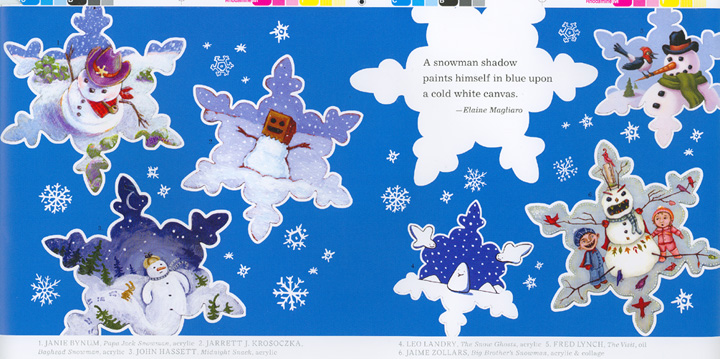
Some of you may have read It's Snowing Art!!!--the blog I posted on Monday. Here is the two-page spread from ROBERT'S SNOWFLAKES for which I was asked to write a haiku poem.


The snowflakes above, from left to right, were created by the following artists:
Janie Bynum, John Hassett, Jarrett J. Krosoczka, Leo Landry, Jaime Zollars, and Fred Lynch.

This is the haiku poem I wrote for "my spread" in ROBERT'S SNOWFLAKES:

A snowman shadow
paints himself in blue upon
a cold white canvas.


Originally posted Dec. 1st, 2006. Click HERE to see original post and comments.

Saturday, November 06, 2010

NEW YORK TIMES BEST ILLUSTRATED


Okay! We're moving on. Check out the New York Times Best Illustrated.


I'm usually disappointed with the picks but I think I really like them this year. They're different... funky... something I haven't seen before. The art isn't the usual fair. What do you think? Not traditional enough? Or just right?

Fat


It's been raining here all week and (partly because of that, partly because family troubles have left me exhausted), I've been letting the kids watch some TV-- normally, I have a No Screen Time policy. Even when allowed to watch TV, some of the kids preferred

and jumping on the mini-trampoline I just bought.

I hate that slack-jawed, glazed, drugged look small children get when they watch TV. Normally, when it rains, we make things or play cards or dress-up
or cook or if there are enough kids over, play hide and seek or sardines or make things with Sculpy or play boardgames .....(another time I will post about these activities: back to the point).

But this week, we watched TV. And maybe because of Meghan's post, maybe because I'm dieting (and you know what THAT makes you think about!), I noticed what the kids on the shows and in the ads were eating. With the exception of the shakes Ricky serves on Hannah Montanna, it was always fast food -- and one episode of I Carly was about her brother making "spaghetti tacos." Another show's plot revolved around kids pretending to be on a ping pong team so they could spend the club money going out to a fancy restaurant -- and what food was dwelt on and lovingly photographed? The cake they had for dessert--one kid was so stuffed he couldn't eat it, so a friend held his mouth open and massaged his jaws so he would chew. The show also showed them grunting with pleasure while they stuffed themselves.

Is it just this week? Was I super-aware of it because of Meghan's post and my diet? Or is this happening all the time? Maybe the BEST way to help kids lose weight would be to show the cool teenagers eating vegetables.

Some of the kids I babysit eat a lot of junk food, none are overweight--but they lead pretty idyllic lives. Some live on a street with other kids their age; they all play outside together after school, every day. Others spend most of the day playing outside on estates like this:
Statistically, the poorer you are, the fatter you are. Obesity correlates more strongly with income than any other factor -- education, geography, intelligence: none matter as much when it comes to being overweight as income. But I bet if all children lived in places as beautiful as this

where it's SAFE to play outside all afternoon, as kids here do, we wouldn't have an obesity epidemic--even if the kids still ate junk food. (Could this be where the income/weight correlation really comes from: where you live? Even in cities, the rich neighborhoods have great playgrounds, the poor ones don't.) Maybe this is simple-minded. But if I were to somehow make a lot of money, I'd some of it to give more children good places to play, and to educate parents about the importance of letting them do that..... and yes, maybe nutrition too. Ack! I hope this isn't preachy. And as I write it, I'm thinking that maybe I could and should do something along those lines NOW. Ideas for what very welcome!

Friday, November 05, 2010

discovering new writers?


Someone posted this comment on the blog and I thought it was interesting (hope you don't mind me reposting this!)

"While I'll always buy books by an author I like regardless of the publisher, from now on I'm going to try to buy mainly from publishers who accept unsolicited manuscripts. It's my way to reward their faith in undiscovered writers."

I was discovered in the slush pile believe it or not. Obviously I only sent my manuscripts out to publishers who accepted unsolicited manuscripts.

It's been a few years (I guess more than a few!) since the day I started to mail stuff out and things have changed a lot. I haven't looked lately at books like the Children's Writer's & Illustrators Market but I know things are harder. I wonder how many houses still accept unsolicited manuscripts. As Alvina can tell you Little Brown is one that doesn't. I know from my experience, however, that a lot of writers can get around the "rules" by meeting editors face-to-face or going to conferences and getting the okay to sub that way. There is always a way around things!

But anyway, I think it's great to reward undiscovered writers. Every new writer deserves the attention or they won't get going with their potential career. I struggled for a while to get noticed and finally found my way when I started doing nonfiction. A frightening new thing in stores like Barnes & Noble is that they are taking away a lot of display space in the kids' department that would be used to display new picture books. There was always the picture book wall (a large wall space to put all the new books out face-out). Now it's gone! It's been replaced by Thomas the Tank Engine and the like. This is scary. Where are the new books supposed to go? In a store like B&N... I don't know. Nowhere. Spine out. How will picture books sell? People will ask for the ones they know: Olivia, Goodnight Moon, books by celebrities... and goodbye new talent. Goodbye anyone who isn't already famous.

I don't know what's happening these days but things are going to become more and more impossible.

Wednesday, November 03, 2010

She Took Trouble


Don't forget to comment for cookies (and books)! We need your suggestions to keep the BRG conversations going!

Right now, I am in the midst of the latest revision for my new novel "Dumpling Days." Not only has my schedule gotten rather full, recently this novel has filled me with anxiety. When I met the lovely Karen Hesse at the Literary Lights event, she asked me, "How are you doing?" in a concerned way and talked to me briefly about how winning an award changes things. At the time, I thought she meant speaking engagements and school visits and I breezily told her things were fine. Things were busy, but not in a way that was extremely unusual or unmanageable. Just an extra stir in soup, so to speak.

But now, I realize she meant the actual writing. I hadn't thought too much about it, but slowly as each revision goes by I've become more aware of my personal phantom hanging over me. "Dumpling Days" is a continuation of Pacy's story from The Year of the Dog and The Year of the Rat, and, like those books, it is highly autobiographical (this one is about my first trip to Taiwan as a child) and light-hearted.

And in the shadow of the Newbery Honor I start to worry--maybe this book is too light, not ambitious enough, not "Literary" with the capital 'L.' But as I begin to let myself get paralyzed, I see that the award only amplified worries and thoughts I've had my whole career. The only difference is my shielding mantra of "Just do the best you can!" has run a bit thin.

So, it was with great comfort that I recently discovered (okay, I know I am really, really late to the party) Just One More Book's podcast of Eva Ibbotson. In her interview she talked about how she knows books about things like escaping the Nazis and suicide are important but she was not the one to write them. She considered her books as personal gifts to her readers and would always work and work to give them what she felt they deserved. In fact, she said she wanted her tombstone to read, "She Took Trouble."


Listening to her was extremely heartening and inspiring to me. It was the right message at the right time. It helped shake away my doubts and transformed the begrudging revisions into acts of love. With any luck, "Dumpling Days" will be a book I will hold proudly and give to my readers with the same warmth as she did.

I'm ashamed to say that I've never read any of Ms. Ibbotson's work--something I intend to remedy immediately! I've already purchased Which Witch? from my local bookstore, but I wasn't sure if that was the best one to start with. Any suggestions?

Tuesday, November 02, 2010

Disappearing Desmond book giveaway


To celebrate the release of my new book, for the first two weeks of November I'll be running a Disappearing Desmond book giveaway! Ten winners will get their very own copy sent to their doorstep.

All you have to do is find Desmond as he appears on various children's book blogs around the web and click on him before the contest disappears. From November 1st through November 14th he will appear on the following sites among others:

Painting Bunnies
Wild Rose Reader
Jama Rattigan's Alphabet Soup
Brimful Curiosities
Katie's Literature Lounge
LadyD Books
Bloomabilities
Gracenotes
From Libby

(And of course here on BRG)

Winners will be chosen at random on Nov. 15th and notified by email. Enter as many times as you like! Simply click on the image below.*


*Please note, US residents only!

Monday, November 01, 2010

The reality of our world


First, some random business.
-Our contest is still ongoing, so if you haven't commented for the chance to win books and cookies, you have until November 10th, so comment here!

-My company celebrated Halloween last Thursday in the office. To take a look at some of the great costumes (and to see who I dressed up as this year), check out my post over at bloomabilities here.

-The NYPL has posted the audio of last week's "Reflections on YA" panel. If you missed out on the discussion, hear what went on here.

And now on to our regularly scheduled program.

****

There have been two blog posts that have lit up the internet (well, my internet, at least) for the past week that have both saddened and enraged me. One is this blog review of a Middle Grade novel, Penny Dreadful by Laurel Snyder. The blog's author, Noël De Vries, liked the book until she came to a depiction of a character who happily lives with her two mothers. De Vries finds some interviews online of the author's motivation for including these characters and writes:

As Snyder writes on her blog, "if more books represented diversity this way, simply, without it being a big issue all the time, more kids would understand that it isn‘t always a big issue. I’d like to think that children’s books are a wonderful way to begin the process of educating people about how varied human experience is, and about how all of it, all of it, is normal." (emphasis mine)

The only problem is, being a lesbian is not normal. It's not something that "just happens" to people, like being poor or brave. In fact, when you look through Biblical glasses, homosexuality is, well, an abomination.

Characters like Willa and Jenny, however, with their happy little family, show elementary-age readers that Christian beliefs are hateful and silly. Add these characters to the full-blown assault of politically-correct propaganda that is molding America's children.

The second blog post is a dating blogger named Maura for Marie Claire Magazine who wrote a post entitled "Should "Fatties" Get a Room (even on TV)?

She writes about the show Mike & Molly and answers this question that her editor asks her: "Do you really think people feel uncomfortable when they see overweight people making out on television?" 

She writes:
My initial response was: Hmm, being overweight is one thing — those people are downright obese! And while I think our country's obsession with physical perfection is unhealthy, I also think it's at least equally crazy, albeit in the other direction, to be implicitly promoting obesity! Yes, anorexia is sick, but at least some slim models are simply naturally skinny. No one who is as fat as Mike and Molly can be healthy. And obesity is costing our country far more in terms of all the related health problems we are paying for, by way of our insurance, than any other health problem, even cancer.

So anyway, yes, I think I'd be grossed out if I had to watch two characters with rolls and rolls of fat kissing each other ... because I'd be grossed out if I had to watch them doing anything. To be brutally honest, even in real life, I find it aesthetically displeasing to watch a very, very fat person simply walk across a room — just like I'd find it distressing if I saw a very drunk person stumbling across a bar or a heroine addict slumping in a chair.

Holy moly. Where do I start? First of all, I also read much of the comments on both blogs, and I have to say, the kidlit community is, for the most part, much more civil and reasonable, even when confronted with beliefs many found extremely offensive and disturbing. On the Marie Claire blog, on the other hand, a large chunk of people hoped that the blogger would die, and both sides resort to immature name calling.

What I'll say about both posts is that they are pretty clear examples of bigotry. And, mind you, I'm talking about what was written in the posts, not about the authors themselves. I'm also not suggesting that homosexuality and obesity are similar in terms of categorizing people, except in the sense that they are both demographic groups, and the groups under attack by these two blog posts.

Although there was much to object to in both posts, there was something that Ms. De Vries wrote in her own defense in the comments that particularly spoke to me. She said:
But my concern is the “writing in” of publicly visible “diverse” characters, when it is done, not because the characters are necessary to the story, but because an author likes “to think that children’s books are a wonderful way to begin the process of educating people….”

As a children's book editor, I can certainly understand how something in a work of fiction can feel forced or contrived so as to take you out of the story and affect your reading and enjoyment of it. That is something all authors strive NOT to do. Everything should feel very fluid and natural and realistic.

However, I cannot emphasize enough how important it is for authors (and TV producers, and movie directors, etc. etc.) to put in diverse characters to reflect the reality of our world. And yes, that includes overweight people. I've said it a thousand times, and I'll say it again: as an Asian American growing up in a very white community, I hungered to see depictions of characters in books and TV and movies that reflected my reality, and sadly there was very little.

When I became an editor, it became one of my missions to publish books featuring underrepresented people. So, I guess I became what the first blogger would call part of the "politically-correct propaganda that is molding America's children." Oh boy. Hide your children from the books I edit!  For a series I was working on a long time ago, I made the suggestion of adding in another minority main character, and the author responded with something to the effect of, Well, we already have this character and that character and this character and wouldn't it be a little too obvious/overkill to add in yet another? At the time, I let it go, because that wasn't the author's reality and if she had forced it in, it would have felt that way: forced (although perhaps not to the child of that ethnic group reading the book...). But the sentiment of it has always bothered me, because the answer is no, it shouldn't be too obvious or overkill, because that exists in reality--in my reality, in other's realities. I've always hung out with a diverse group of friends. A former colleague of mine who was Mexican-American said that when he was in high school, his two best friends were an Asian guy and a black guy. And that was how it was. That was their reality, not a fake depiction of diversity in a book or TV show. And so, as an editor, I now try to find a diverse array of voices whose realities reflect our diverse world.

Author Jackie Dolamore stated it very succinctly in her comment:

My books reflect the world around me. I only have one book published so I can't say there is a HUGE amount of diversity there, but I know wonderful people who are gay, I know wonderful people who are devoutly religious. I know lots of different people in life, so when I write, if I didn't reflect that, it wouldn't feel real to me. I don't think all writers who include gay characters are trying to push a pet agenda, many of us are just reflecting the world we live in, just as if I write about a devoutly religious character I'm not pushing a religion because I don't belong to one, I am reflecting my world which includes many wonderful devoutly religious people.


Sorry to be preachy, but to Noël and Maura, I will just say: we have all kinds of people in the world, and we need that to be reflected in our media. Please, just practice tolerance and acceptance. Or if not acceptance, then I'll settle for tolerance. If you don't want to watch, if you don't want to read, then just look away. But allow others who do want to read and do want to watch do so. And allow those of us who are lesbians or obese exist and be happy, even. Your reality is not my reality, but we have to live in the same world. As Roger Sutton stated so succinctly, "not everything is about you, dear."


Note: after writing this post, I came across author Laurel Snyder's excellent response to the review.